Why Your Business Isn’t Showing Up in ChatGPT: The New Era of SEO Beyond Google
The Silent Shift in Search Behavior
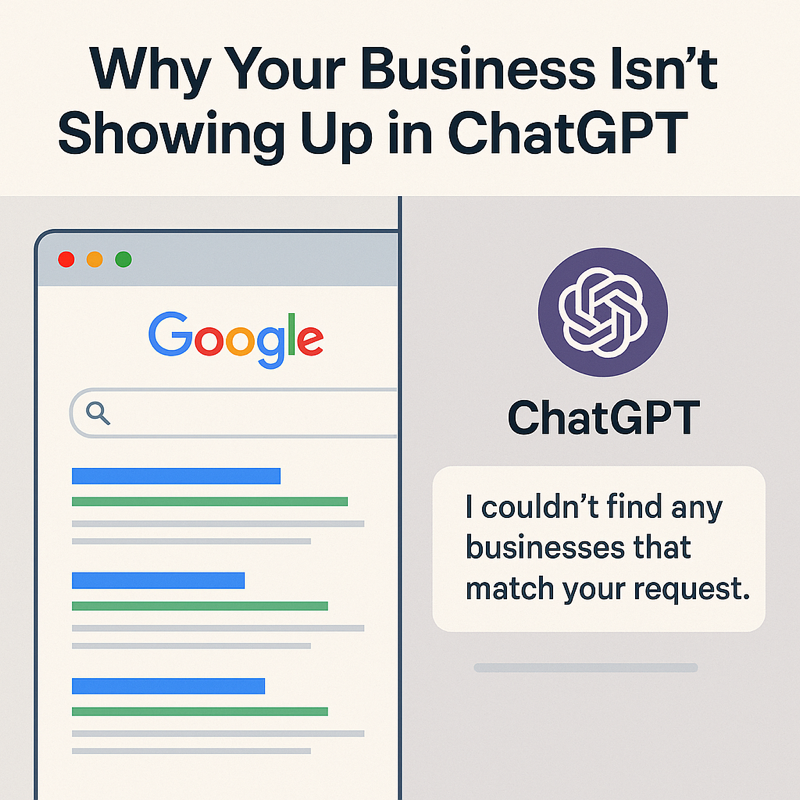
Most businesses still optimize for Google, but that’s no longer the whole picture. As AI tools like ChatGPT, Claude, and Perplexity become mainstream entry points for discovery, your brand’s visibility may be vanishing from the places people are now looking. At EdIT Creative, L.L.C., we specialize in strategic foresight—designing digital presence for where search is going, not where it’s been.
Traditional SEO and Schema Aren’t Enough
Classic SEO relies on structured website data (such as Schema.org markup), keyword density, and backlinks to help search engines crawl and rank content. But when someone asks ChatGPT for a recommendation, “What’s the best creative agency for go-to-market strategy in Utah?”—the model doesn’t “crawl” your website in real-time. Instead, it relies on its training data, curated sources, and semantic memory from technologies like Retrieval-Augmented Generation (RAG).
The result?
-
-
- Your perfectly optimized homepage may never be seen.
- Your blog content might not surface unless it’s explicitly cited or embedded in trusted datasets.
- Even an accurate Schema doesn’t guarantee mention unless models associate your brand with high-confidence context.
-
The New Search Landscape: LLMs, Not SERPs
Large Language Models (LLMs), such as ChatGPT, interpret and synthesize information rather than indexing it. Their responses often skip direct links and summarize “most likely” answers based on what’s been seen in large swaths of the internet. This radically changes what “ranking” means:
| Traditional SEO | LLM Discovery |
| Rankings in Google results | Mentions in model outputs |
|
Structured metadata |
Contextual associations |
|
Crawled pages |
Pretrained + curated knowledge |
|
Backlinks |
Trusted source integration |
Why Visibility is Fading for Unprepared Brands
Many companies assume that if they rank on Google, they’ll also show up in ChatGPT responses. But this assumption is flawed.
Unless your brand is:
✔ Cited in frequently used LLM datasets
✔ Mentioned in forums, thought-leadership content, or high-authority publications
✔ Structured in a way that aligns with how models are fine-tuned
…you may be invisible in the new AI-first discovery layer.
What Businesses Can Do (and What We Do at EdIT Creative)
At EdIT Creative, we’ve developed future-focused strategies to help brands stay visible in AI-powered ecosystems:
1. Brand-LLM Alignment:
We position your business in the types of digital environments LLMs “learn” from, like expert publications, forums, public knowledge bases, and industry-specific wikis.
2. AI-Optimized Content Strategy:
We don’t just write for Google, we write for humans and machines. This means structured content that’s both semantically rich and citation-friendly.
3. Presence in Structured APIs and Trusted
Databases:
Getting your business listed in high-trust, structured repositories (e.g. product databases, public directories, academic citations) that feed into AI systems.
4. AI Identity Management:
We help you manage your digital identity as perceived by AI, ensuring accurate, reputation-enhancing information is available across data sources.
Case Example: Go-To-Market Visibility
For one client launching a specialized product in the sustainability sector, traditional SEO earned page one rankings, but not visibility in ChatGPT summaries. After repositioning their content for LLM indexing and securing citations in key publications, their brand began surfacing in conversational AI queries like “Who offers eco-friendly packaging strategy services?”
Prepare for AI-First Discovery
At EdIT Creative, L.L.C., we don’t just build visibility. We architect your discoverability across search engines, AI systems, and emerging digital pathways.
Want to know how visible your brand is in AI-driven search?
Contact us for a Visibility Audit and let’s future-proof your digital strategy.